
Budget Breakdowns
Four Key Takeaways from the U.S. Department of Energy’s Proposed FY26 Budgets
By Paul Donohoo-Vallet, OP alum and Policy Strategy Lead for the U.S. Department of Energy Alumni Network
December 17, 2026
Administration proposed cuts; Senate appropriations bill largely would maintain funding
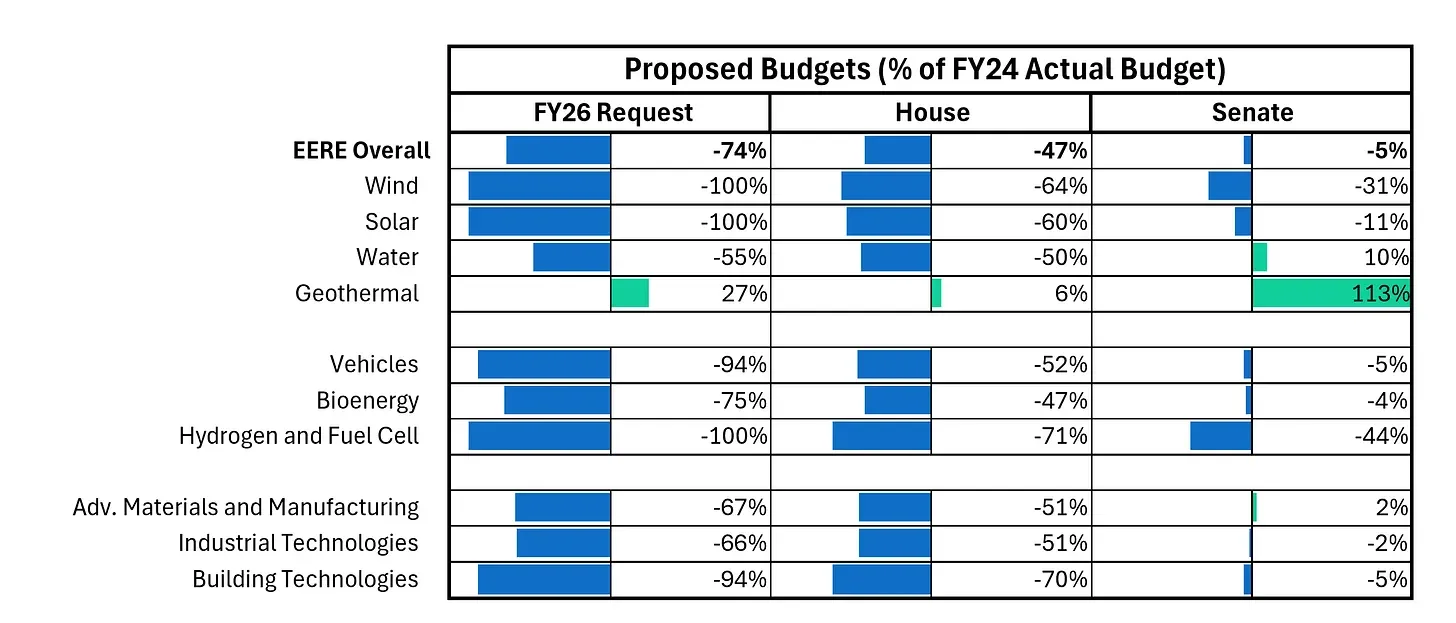
Back in May of this year, the President proposed the Fiscal Year 2026 Budget Justification (FY26 budget) for the U.S. Department of Energy (DOE) that significantly cut or fully eliminated many technology areas, including elimination of the wind, solar, and hydrogen technology offices, along with DOE’s State and Community Energy Program supporting energy efficiency and weatherization activities. Other technology offices facing significant cuts included a 95% reduction (from FY24 levels) of the Vehicles Technology Office, 94% reduction in the Building Technologies Office and 60% cuts to industrial efficiency offices. Within the Office of Energy Efficiency and Renewable Energy (EERE), only the Geothermal Technology Office would see a major increase in the proposed budget of 27%.
Offices outside of EERE also face funding cuts in the FY26 Budget Request: 30% to 50% reductions (from FY24 levels) in the Office of Electricity programs focused on energy storage and distribution system technologies, a 25% reduction in the Office of Cybersecurity, Energy Security, and Emergency Response, 52% reduction in the office focused on carbon capture and utilization, and a 18% cut across to the Office of Nuclear Energy (NE).
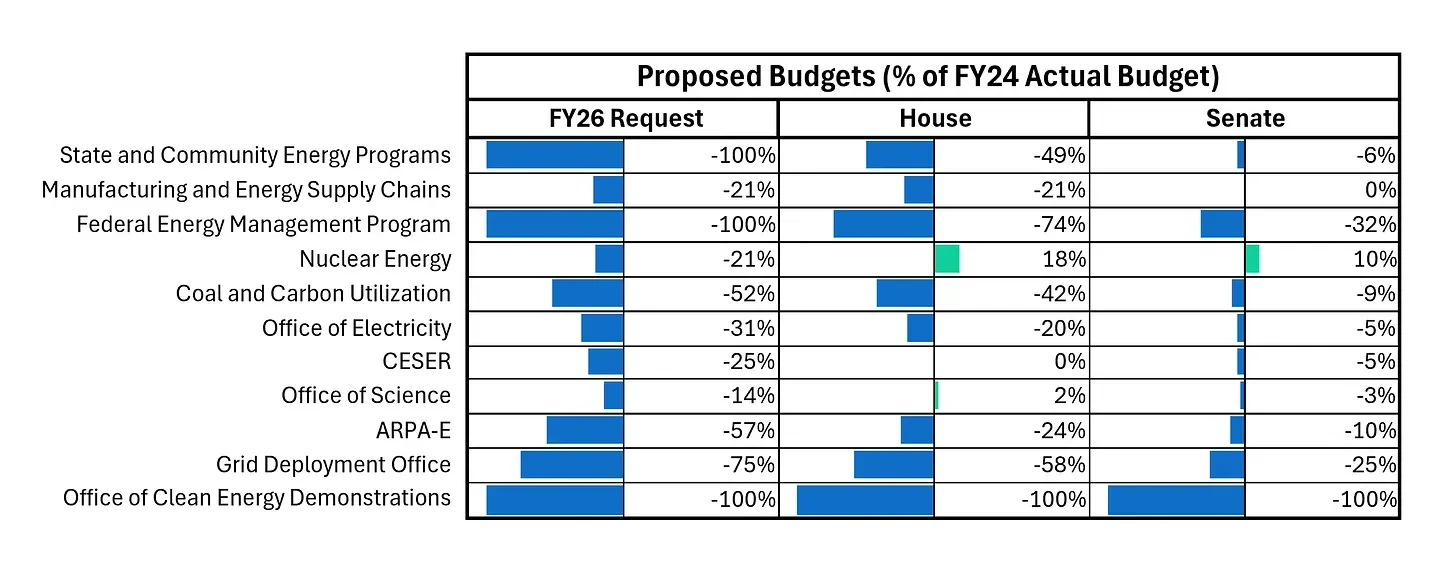
Over the summer, the U.S. House of Representatives passed an appropriations bill that would fund these offices modestly higher than the Administration’s proposal. Then, just before Thanksgiving, the U.S. Senate released a draft bill that generally reverses the proposed eliminations and major cuts, with funding near FY24 levels for most of the technology offices. For example: the House bill proposes a 64% cut to the Solar Energy Technologies Office, while the Senate bill reduces the cut to 31%. For the Wind Energy Technologies Office, the House proposes a 64% cut while the Senate bill reduces it to an 11% cut.
Only the Office of Clean Energy Demonstrations (OCED) remains eliminated across the Administration’s proposal, House bill, and Senate bill.
Proposed recissions of $15 billion in unobligated Infrastructure Investment and Jobs Act funds mostly ignored in Senate bill
The FY26 budget request included rescinding $15.2 billion of unobligated funds provided under the 2021 Infrastructure Investment and Jobs Act (IIJA). The rescissions would affect nearly all of DOE’s IIJA programs, from major energy technology demonstration projects and power sector infrastructure investments to smaller budget programs providing technical assistance and training to rural electric utilities and local governments. Major proposed rescissions include:
$3.2 billion from the Grid Resilience and Innovative Partnerships (GRIP) Program in the Grid Deployment Office (GDO)
$2 billion from Carbon Dioxide Transportation Infrastructure and Financing (CIFIA) in the Office of Fossil Energy (FE), intended to help develop CO2 transportation systems for carbon capture projects
$2 billion from the Regional Direct Air Capture Hubs in OCED
$1.9 billion from the Carbon Capture Demonstration Projects and Large-Scale Pilots Programs in OCED
$1 billion from the Civil Nuclear Credit Program (CNC) in GDO, intended to support existing nuclear reactors facing economic retirement
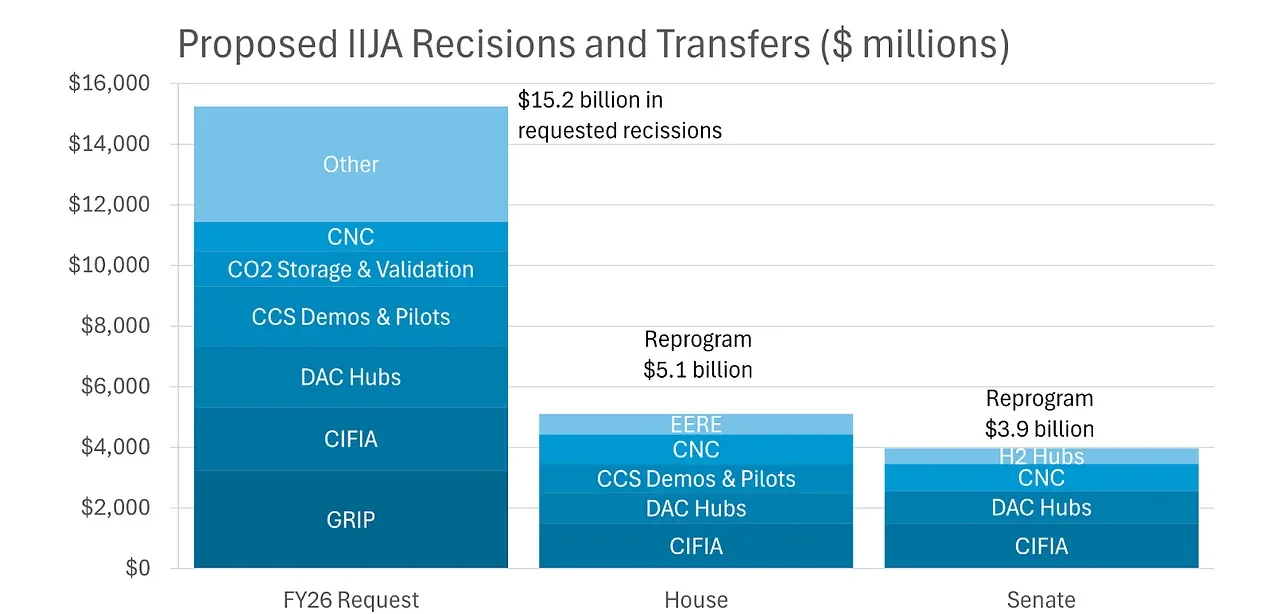
The Senate bill does not directly rescind any of the funds identified in the budget request, but it would transfer a lower total of funds from some of the IIJA programs identified for rescission to partially offset the annual accounts for a few offices and to fund new programs. For example, it includes transferring $1 billion from Regional Direct Air Capture (DAC) Hubs to fund EERE, and transferring over $500 million from Hydrogen Hubs to partially fund NE, Office of Fossil Energy, Grid Deployment Office, and Office of Science.
Similarly, the House bill does not advance rescissions, but it does transfer a total of $5.1 billion from IIJA programs - all to pay for Gen III+ nuclear demonstrations, as discussed below: $1 billion from Regional DAC Hubs, $950 million from OCED’s Carbon Capture Pilots and Demonstrations programs, $1.5 billion from FECM’s CIFIA program, and $673 million across four EERE programs.
All three funding proposals include broad support for programs advancing nuclear deployment
The Administration’s budget proposal includes only a few budget increases or program expansions, mostly notably a request for a $750 million increase in credit subsidy to support loans for new small modular reactors (SMRs) and advanced nuclear reactors. Based on the way credit subsidies work, this would enable the Department to support additional loans of likely $10 billion or more. The House appropriations bill supports this idea but would provide a lower amount of only $150 million increase in credit subsidy. This lower amount would proportionally enable a smaller loan authority of only a couple billion, possibly not sufficient for capital intensive nuclear projects. The Senate bill would not provide any increased credit subsidy.
However, both the House and Senate appropriation bills would transfer some IIJA funds to further support the Department’s ongoing Advance Reactor Demonstration Projects (ARDP) and recently selected projects for new light-water SMRs. The House would transfer over $5 billion from various IIJA programs (including CIFIA, CNC, Regional DAC Hubs, and Carbon Capture Demonstrations and Pilots) in order to further support the two reactors already selected under ARDP and additional selections under the Generation III+ Small Modular Reactor (Gen III+ SMR) Pathway to Deployment Program. The Senate bill would transfer a smaller amount of $2.4 billion derived from CIFIA and CNC for similar purposes.
Senate bill seeks to curtail further DOE project cancellations
In response to the actions DOE has taken this year to cancel significant amounts of already-awarded projects, the Senate appropriations bill has a new section that seeks to put more restrictions on how DOE could further cancel projects. Section 316 would require DOE, prior to any terminations, to provide 120 days of advanced notification to the recipient and include the opportunity for the recipient to rescope the project. For any recipient that eventually does have a termination, they would be prioritized for selection in any relevant future funding opportunities.
The scope of this section is limited however, as it only applies to IIJA awards that have been announced prior to November 1, 2024, and does not apply to any projects that have already received terminations.
What’s Next
The federal government is currently still operating on a Continuing Resolution which holds funding at FY24 levels and will expire on January 30, 2026. Congress will need to reconcile major differences between the House and Senate proposals for DOE on cuts to technology offices and any rescission or repurposing of remaining IIJA funds in order to pass a final budget.
###
This piece was drafted by trusted and vetted alumni of the U.S. Department of Energy. Any views and opinions expressed are that of the author(s) and do not reflect those of the DOE Alumni Network.