
Budget Breakdowns
The Last Mile of Energy Delivery: What the FY27 Proposal Means for SCEP's Successor Programs
By SCEP alums Greg Dierkers and Chris Castro and additional SCEP alumni
May 7, 2026
The U.S. Department of Energy’s (DOE) Fiscal Year 2027 (FY27) budget proposal proposes to eliminate funding for the Office of State and Community Energy Programs (SCEP), including two long‑standing programs, the State Energy Program (SEP) and the Weatherization Assistance Program (WAP) as well as Training and Technical Assistance.
SEP and WAP predate SCEP but are program pillars and aligned with the goals and needs of today. WAP dates back to the oil crisis of the early 1970s, and was launched in 1976 to help homeowners save energy. SEP followed in 1996, helping formalize support for state-led energy innovation.
Alongside funding, SCEP also provides technical assistance - resources and tools that collectively allow state and local governments to meet basic energy needs while achieving their future energy goals. While federal energy debates often focus on generation and infrastructure investments, SCEP programs serve a different function: they are delivery, oversight, and accountability mechanisms that connects federal energy policy to local programming to lower household energy bills, weatherize homes, train workforces, and improve state and local capacity to execute complex federal programs, such as the $8.8 billion in home energy rebates established through the Inflation Reduction Act.
Here’s a quick snapshot of the programs SCEP administers:
Workforce Development
State-Based Home Energy Efficiency Contractor Training Grants: Provides funding to train, test, and certify residential energy contractors.
Building Training and Assessment Centers Program: Funding to establish building training and assessment centers that educate and train building technicians and engineers to deliver energy efficiency upgrades to businesses and institutional buildings.
Career Skills Training Program: Funding for career skills training programs under which students concurrently receive classroom instruction and on-the-job training to obtain an industry-related certification to install energy-efficient building technologies.
Energy Auditor Training Grant Program: Funding to train individuals to conduct energy audits, or surveys, of commercial and residential buildings, and advise building owners on how to reduce energy usage that result in energy savings.
Home Energy Efficiency Upgrade Programs
Home Electrification and Appliance Rebates Program: Allows states and federally recognized Tribes to develop high-efficiency electric home rebate programs for lower income households.
Home Efficiency Rebates Program: Allows states to create rebate programs for energy efficient residential retrofits.
Weatherization Assistance Program (WAP): Increases the energy efficiency of low-income households, reduces total residential energy expenditures, and improves health and safety for the elderly, people with disabilities, and children.
Building Codes
Latest Model and Zero Energy Building Code Adoption: Provides funding to states, localities, and territories with the authority to adopt building energy codes and innovative building energy codes in new and existing residential and commercial buildings.
State, Local Governments, and Partnership
State Energy Program (SEP): Provides funding and technical assistance to states, territories, and the District of Columbia to enhance energy security, advance state-led energy initiatives, and increase energy affordability.
Energy Efficiency and Conservation Block Grant (EECBG) Program: Invests in clean energy and energy efficiency projects in more than 2,700 communities across the country—reaching 250 million Americans. Recipients deploy funds to develop and implement a wide range of energy plans and programs.
Energy Futures Grants: Supports place-based innovative policies, programs, and infrastructure investments by funding teams of government, business, and community organizations to work to enhance energy affordability.
School and Nonprofit Programs
Renew America’s Schools: Provides competitive grants that position school districts to make upgrades to lower facilities’ energy costs and foster healthier learning environments for students.
Renew America’s Nonprofits: Competitive grants that improve health and safety and lower utility costs at buildings owned and operated by 501(c)(3) nonprofits.
Eliminating SCEP funding would reduce services and would impact programs created by Congress to stretch federal funding and ensure taxpayer dollars are implemented efficiently, equitably, and at scale. Over $400 million provided by core SCEP programs is leveraged many times over by communities across the country, often in creative ways designed to meet their unique needs.
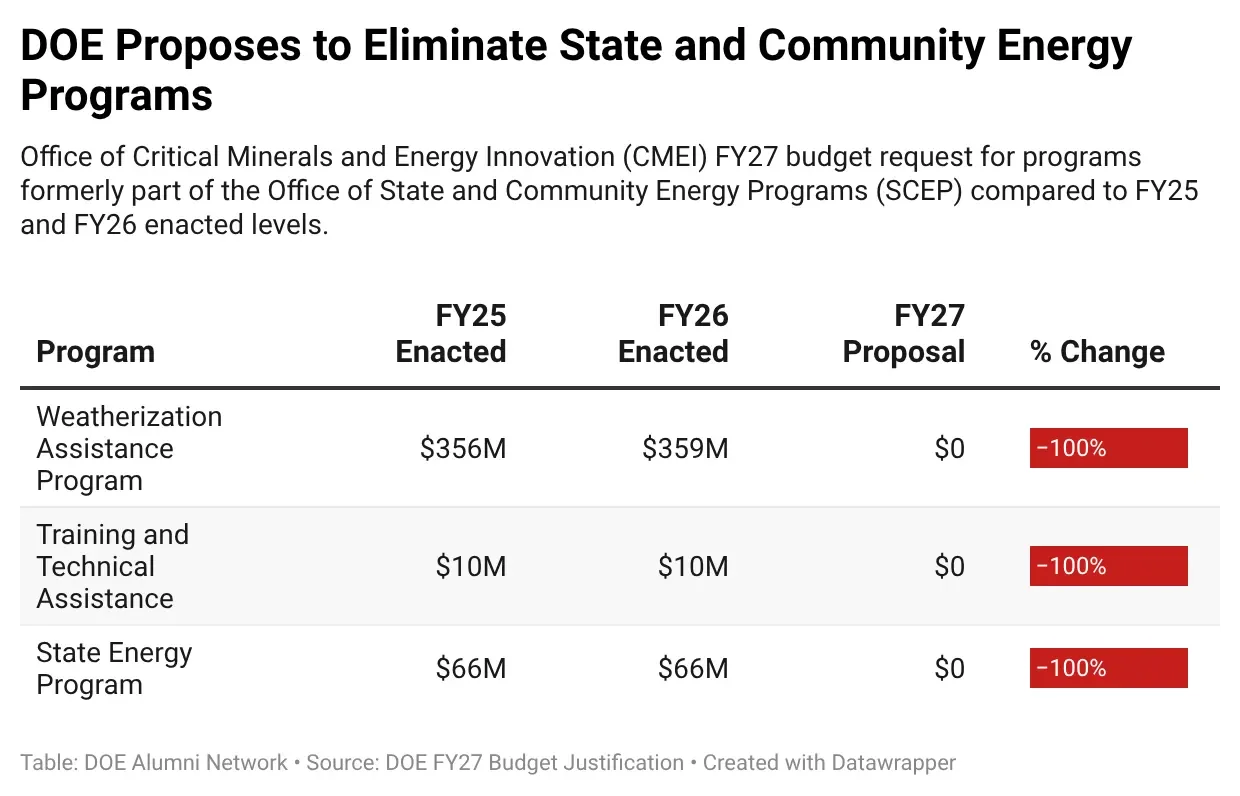
That connective, people-centered resource is what SCEP has built and maintained over decades. Though SCEP has been reorganized by DOE into the Office of Innovation, Affordability and Consumer Choice within the Office of Critical Minerals and Energy Innovation (CMEI), the underlying delivery system across the three annually appropriated SCEP programs relies on the same combination of formula grants to states, Tribal governments, and territories; competitive awards to local governments; and technical assistance supporting program design, procurement, compliance, and deployment.
The FY27 proposed funding levels would eliminate SCEP programs that provide support to local governments across these areas. This would reduce the number of weatherized homes, upgraded schools and other community facilities, and make it more challenging for local governments to lower energy bills for families.
Historically, Congress has supported SCEP core programs, directing DOE to maintain their budgets and delivery functions. Within the FY27 Budget Justification document DOE provides no explanation for why SCEP should receive zero appropriations.
SCEP Supports State and Local Capacity to Deliver Energy Programs
For those outside of government, "administrative support" and "technical assistance" are not always easy to describe. In short, they complement and leverage funding and can complement state and local energy goals. State energy offices in all 56 states and territories don't just receive federal funds — they manage contractor pipelines, train auditors, develop State Energy Security Plans, and serve as the operational backbone for programs like SEP. When technical assistance to State energy offices is reduced their capacity to manage these programs is limited. As a result program delivery within states slows down and skilled workforces such as contractors and auditors supporting these programs become less engaged and ultimately may move on to other workstreams and industries.
Similarly, WAP supports DOE’s objectives to lower energy bills while expanding cost-effective energy choices for all American communities. It has weatherized more than 7.2 million homes since the program began, delivering 32,000 low-income residential energy retrofits each year, and saving households $372 per year on average in lower energy expenditures.
Deploying WAP funds effectively requires a robust network of Community Action Agencies across each county jurisdiction, trained and qualified contractors to perform the work, and a required pipeline of weatherization ready homes that have addressed health and safety issues before weatherization begins. Without WAP, homes get “deferred”, insulation, ventilation and other measures may not get deployed, and energy costs will likely continue to rise with household electricity rates. Prior WAP evaluations and Congressional Research Service reports note that health and safety deferrals are already a major constraint for states. A WAP program evaluation program reported that: “Homeowners felt safer, more comfortable, and healthier in their homes, and reported financial savings that would allow them to pay for other necessities.”
Proposal Would Imperil Effective Implementation of Infrastructure and Energy Saving Programs
Alongside SEP and WAP, SCEP programs provide technical assistance, and funding to collectively support state and local governments in managing and implementing other programs that provide energy benefits and save communities money. Major IIJA programs still have significant appropriations remaining to distribute outside of annual appropriations and without SCEP support communities could see further delays in realizing the benefits of these programs.
For example, the Energy Efficiency and Conservation Block Grant (EECBG) program received a $550 million appropriation under the IIJA in 2021 and has historically extended federal energy resources to more than 2,000 local jurisdictions. Without SCEP technical assistance and directed support under programs like EECBG, smaller and rural communities – which often have limited staff and less procurement capacity – are likely disadvantaged relative to larger and better resourced towns and cities. The result is a smaller and less balanced system in which rural residents miss out on opportunities to improve their schools, buildings, and transportation programs.
Technical assistance also operates hand-in-hand with programs like SEP. For example, it allows a group of small towns in North Carolina to navigate federal procurement requirements and use energy savings performance contracts to save over $1.2 billion in taxpayer dollars on energy costs in public buildings. This saves scarce taxpayer resources and helps local governments invest in their facilities when they might not have been able to on their own. Without the technical assistance and support, future savings like this would be lost.
SCEP has been critical in distributing and supporting initial state implementation of the $8.8 billion in Home Energy Rebate programs established through IRA. Early movers under this program like Georgia, and Arizona have already delivered savings for households - the latter of which has provided 523 rebates and saved households over 275,000 kilowatt-hours. Without SCEP support, delivering on these savings in other states creates delays and ultimately impacts eligible applicants who can benefit from these cost-savings. During a budget hearing on April 15, 2026, Secretary of Energy Chris Wright indicated the remaining rebate funds would likely be released “in the near future.”
Practical Questions the Proposal Leaves Open
Several implementation questions follow directly from the proposed reductions in SCEP that the budget documents don't answer:
What is the substitute for rural communities who would otherwise benefit from support for affordable energy?
Who at DOE will provide oversight on the administration and distribution of remaining funds through the Home Energy Rebates programs to ensure cost-saving benefits are delivered to qualifying consumers?
How will states meet their local energy security via State Energy Security Plans with reduced support?
As Tribal funding rolls out, will federally-recognized Tribes receive their share of EECBG funding? Who will provide oversight?
How will local government compliance with federal requirements for federal funding (such as on sourcing domestic materials, paying prevailing wages, and environmental assessments) which has historically been supported through SCEP technical assistance be maintained without SCEP support?
What financial burdens and health impacts will be faced by consumers who would otherwise qualify for WAP if the program is eliminated?"
SCEP programs are about people, homes, local workforces, and communities with federal funding that is delivered through a system of state and community partnerships that have been built up over decades. If the system shrinks, the ability to deliver reliable and accessible energy and cost savings to consumers will take time to recover and be unable to respond to rising energy costs.