
Updates from DOE
GAO Finds DOE Shifting of Fiscal Year 2025 Funds Likely Violate Law
By Janie Thompson, CI alum, and Paul Donohoo-Vallett, OP/EERE alum
June 17, 2026
On June 4, 2026, the Government Accountability Office (GAO) released a report which investigated the transfer of funds between offices at the U.S. Department of Energy (DOE) during the Fiscal Year 2025 (FY25) Continuing Resolution (CR). GAO found that DOE’s Fiscal Year 2026 (FY26) congressional budget justification reported FY25 "enacted" amounts that were different from amounts appropriated to DOE in Fiscal Years 2024 (FY24). GAO finds these actions are likely in violation of the Antideficiency Act should DOE obligate funds at those levels. This article unpacks what happened and why GAO reached that conclusion.
Congress Directs Appropriations Both in Law and Accompanying Committee Reports
Every Fiscal Year, both the House and Senate Appropriations Committees work to produce 12 funding bills and an accompanying report, also known as Explanatory Statements. The report includes clarifying directions, spending tables, and earmark details, if applicable. In a regular year, each chamber votes both in Committee and on their Floors to pass the bills and reports as a joint package.
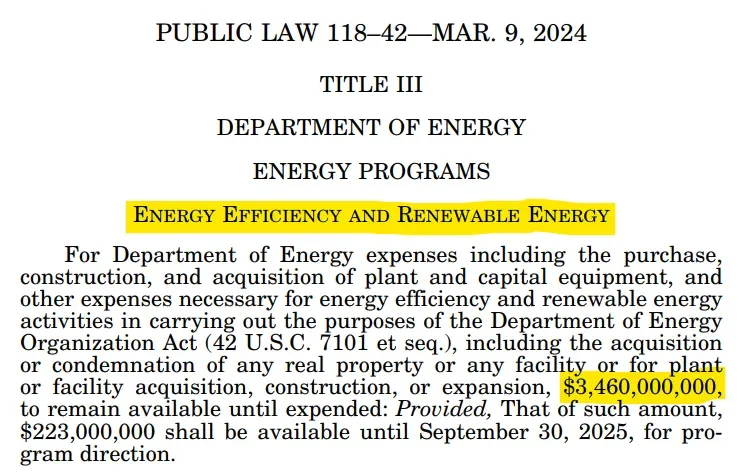
For DOE, the annual appropriation for top-level program budgets are contained in the appropriation bill language. Generally this is only the top level budget, with a set aside to be used for program direction (i.e. staffing), and potentially one or two other very specific instructions. For example, below for FY24 the appropriations bill (p. 25) identifies $3.46 billion only for the Office of Energy Efficiency and Renewable Energy (EERE) and does not mention any further specific spending within EERE program offices.
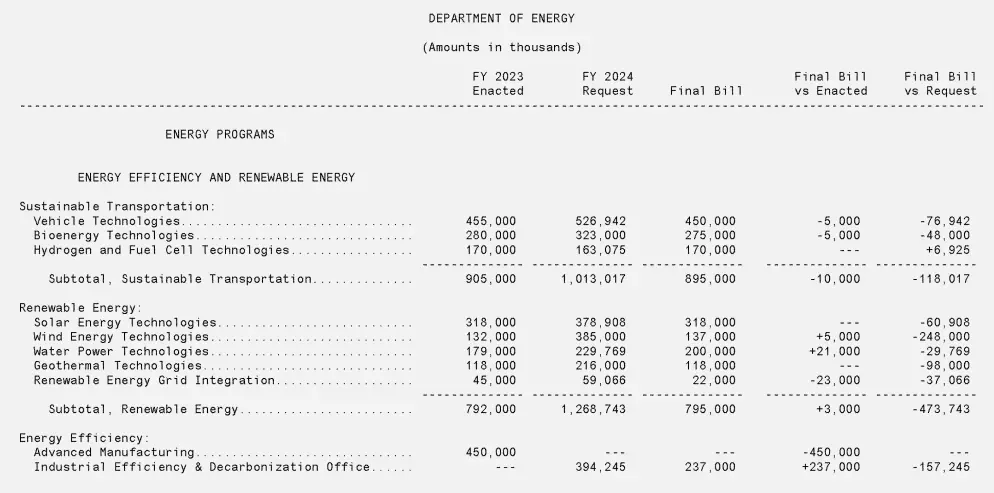
The committee reports are where Congress designates the program budgets for programs within those top-level budgets. For example, the committee report contains more specific budget tables (p. S1581) for EERE programs, such as the Wind Energy Technologies Office (WETO) and Solar Energy Technologies Office (SETO). Sometimes the report prose also names more specific spending within a program level budget. Here is an example of the budget tables contained in the committee report for the sustainable transportation and renewable power programs within EERE for FY24:
A Continuing Resolution Keeps Budget Levels Constant
Congress often funds portions of the government - or sometimes, nearly all functions of government - through a CR when it is unable to reach bipartisan agreement on a fresh appropriations bill for the current Fiscal Year. A CR simply pro-rates the most recent formal spending bill for some specified period of time, together with the policies that were agreed to for that prior year, with a very limited number of specified anomalies.
For example, if “Agency A” is funded at $100 million for FY26 and Congress is unable to pass an Fiscal Year 2027 agreement by September 30, 2026, it might pass a three-month CR to give itself more time to negotiate. During those three months, “Agency A” would be funded at $25 million (one fourth of $100 million) and all the prior Fiscal Year’s instructions would still be in effect.
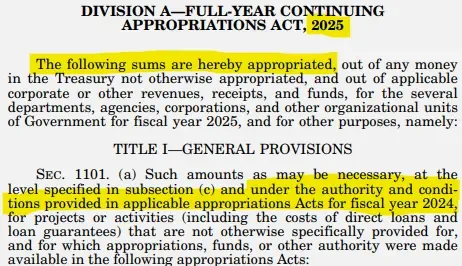
This happened in March of 2025. Congress had already been funding the government under a CR for the first six months of the Fiscal Year, and in March, it decided to simply carry through the FY24 levels for the balance of FY25, rather than continuing to try to negotiate a full, updated budget. Aside from some specified anomalies related to amounts appropriated for the National Nuclear Security Administration, Congress simply referred to amounts appropriated for 2024 in the FY25 CR:
DOE Reported That it Shifted Funds Across Program Offices Under the FY25 CR
DOE argued that because the FY25 CR did not directly reference the accompanying budget tables in the committee report for FY24, only the top-line budgets provided in the actual FY24 appropriations law were in force for the FY25 CR, and the report could be ignored. Accordingly, DOE believed they could move funds around between lower-level program offices at their discretion so long as they stayed within the top-line budgets.
DOE’s budget justification documents for the proposed FY26 budget contained budget tables which showed FY25 budgets differed from what was enacted for FY24. It appears that DOE shifted funds around within six different budget accounts: EERE, Fossil Energy, Nuclear Energy, Science, Non-Defense Environmental Cleanup, and Uranium Enrichment Decontamination and Decommissioning.
For example, within EERE the total budget remained at $3.46 billion between FY24 and FY25 CR, but $949.9 million appears to be shifted away from a handful of programs (including solar, vehicles, buildings, hydrogen, and wind programs) to a handful of others (including geothermal, industrial, manufacturing, and water power programs). See the table below for the details:

GAO Concluded the Program Level FY24 Budget Tables Apply for FY25; DOE Programs at Risk of Violating Law
In its ruling published on June 4, 2026, GAO answered that DOE’s attempt at shifting program level funding under the FY25 CR would be unlawful, should DOE actually obligate money in excess of those levels. Congress wrote the FY25 CR to ensure that the committee report language from FY24 carried over along with the bill language, and that as such the FY24 committee report and the budget tables it contained still had the force of law under the FY25 CR.
GAO cited two laws limiting DOE’s ability to spend funds in this manner:
The Purpose Statute says agencies can only use funds appropriated to a line item for the objective of that line-item. It cannot shift them to another account.
The Anti-Deficiency Act prohibits an agency from obligating or expending funds in excess of what Congress appropriated.
GAO noted that a violation of the law could only happen once DOE actually obligates money in excess of the budget Congress provided. DOE’s listing of different amounts under the FY25 CR budget tables as an intention to spend to that level is not itself a violation of the law.
While GAO indicated that some of the programs may have obligated in excess of their budgets, they could not confirm whether violations actually happened without further detailed account information from DOE and OMB - and neither agency has responded to GAO’s request for information. GAO needs information from DOE and OMB in part because DOE has access to funding not tied to any particular Fiscal Year and funds that are carried over from prior Fiscal Years, which could hypothetically enable DOE to spend in excess of annual appropriation without violating the Anti-Deficiency Act.
Conclusion
With this opinion in hand, appropriators will look for DOE to affirm it has restored funding to SETO, WETO and other key accounts in accordance with the requirements of the FY24 report. GAO’s conclusion that the committee reports that accompany annual appropriations bills are indeed binding for federal agencies is a significant opinion that should strengthen, or at least affirm, Congress’ power of the purse.