
Budget Breakdowns
Quick Hits: House FY27 Budget Marks
By Nick Montoni, EERE alum; Janie Thompson, CI alum; and Paul Donohoo-Vallett, OP/EERE alum
June 9 2026
On May 20, 2026, the House Appropriations Committee’s Energy and Water Development Subcommittee released its Committee Report to accompany the Fiscal Year 2027 (FY27) appropriations bill. The bill provides $50 billion for the Department of Energy (DOE), a 3% increase over FY26 levels, but the bill and report do much more in directing how the Department spends its funds. Notably, this bill makes certain changes to oversight, management, and transparency requirements to ensure the appropriate use of funds. Here we highlight a few major takeaways from the House bill across the DOE enterprise.
Major Cuts to Most Clean Energy Programs
While the House bill rejects the proposed defunding of mostly clean energy technology offices, the proposal would still result in major cuts. The new Integrated Energy Systems office formed from combining the wind and solar programs would see a 50% cut from FY26 levels. Other clean energy offices across clean fuels, transportation technologies, energy efficiency, carbon capture, and industrial technologies would see 30% to 66% budget cuts.
Only geothermal and nuclear avoid cuts. The geothermal program matches the FY26 levels and the administration’s request, while the nuclear energy office would see a 7% boost,
The bill would codify the reorganization of most of the clean energy programs under the new Office of Critical Materials and Energy Innovations (CMEI), by reflecting the new names and structure within the budget tables.
Weatherization and State Energy Programs Left Intact
The administration’s budget requested to eliminate funding for these programs out of the Office of State and Community Energy Programs. The House bill instead would hold these programs at the FY26 enacted levels, possibly recognizing the longstanding support for these programs focused on providing support for those with energy affordability challenges.
Significant Increase to Nuclear Weapons Production Budgets
The National Nuclear Security Administration (NNSA) would see a significant 7% increase in the House bill, primarily due to a proposed $1.3 billion increase in Production Modernization activities that would increase plutonium pit production. This matches the administration's requests for these activities, with additional language in the bill highlighting this shift:
“The recommendation strongly supports efforts to modernize the nuclear weapons stockpile, increase investment in NNSA’s infrastructure, prevent the proliferation of nuclear materials, and provide for the needs of the naval nuclear propulsion program […] Within funding for NNSA’s Weapons Activities, the recommendation continues robust support for the multi-year modernization plans for the Nation’s nuclear weapons stockpile and its supporting infrastructure. The Committee recommendation fully funds plutonium pit production at both the Los Alamos National Laboratory and the Savannah River Site […]”
Additional Transfers of Unobligated IIJA Funds to Boost Nuclear Demonstration Programs; No Additional Funds for Baseload or Genesis Mission Proposals
Continuing the trend from FY26, the House mark seeks to reprogram $2.8 billion of unobligated Infrastructure Investment and Jobs Act (IIJA) balances across carbon management and clean energy programs to support the existing two projects under the Advanced Reactor Demonstration Program along with Generation 3+ Small Modular Reactor (SMR) projects. In addition, it provides $100 million in credit subsidy specifically for loans for new SMR projects out of the office of Energy Dominance Financing, formerly known as the Loan Programs Office. This would be in addition to similar reprogramming of over $3.5 billion of IIJA funds for nuclear demonstration and loans for SMRs that were already enacted in the FY26 budget. The House proposal notably again ignores the Administration’s request for straight rescission of $15.2 billion in unobligated IIJA funds.
The $594 million proposed to be transferred from the Carbon Dioxide Transportation Infrastructure Financing Innovation program (CIFIA) would zero out the budget for that account, as the majority of CIFIA funds were already reprogrammed in FY26.
Notably, there are no transfers specifically for the big ticket items requested by the administration: no $3.5 billion for a new “Baseload Power Initiative," nor $1.2 billion for the “Genesis Mission”, only a small 3% boost to the Office of Science annual budget.
Increased Oversight of Grants and Financial Management
The House bill includes three provisions that give Congress more oversight over the Department’s efforts to manage grants and financial assistance:
Termination notification: Section 301 requires the Department to notify both House and Senate Appropriations Committees at least three business days in advance of terminating any award over $1 million. This provision was included in the final FY26 agreement, and is again here proactively as a response to the unprecedented mass grant cancellations last year.
Project management: Section 305 requires that awards over $100 million be carried out according to internal project management procedures. This is a new section not in the FY26 budget, and highlights Congress’ heightened attention on DOE’s project management processes.
Indirect costs: Section 312 holds indirect cost steady at the levels previously outlined in law. Previously DOE had sought to significantly reduce the indirect cost rate.
Taken together, these provisions are designed to give Congress slightly more oversight of the Department’s management of its financial awards, and likely is a result of DOE’s project terminations over the last year. The Committee report, which contains instructions for the Department, also directs the Department to continue paying invoices in a timely manner, to ensure award recipients receive agreed upon funding at the appropriate times, notable only in the fact that these are actions that DOE would be expected to be taking regardless of Congressional direction. Their presence in the report indicates that Congress may be hearing of challenges that awardees are facing in receiving DOE payments.
Transparency and Reporting
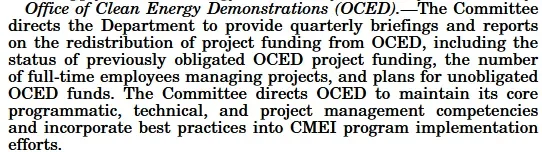
The House bill would also direct the Department to increase the type and frequency of reporting. DOE is directed to increase reporting on the status of funds and projects that were originally the purview of the Office of Clean Energy Demonstrations (OCED). This office was created by the IIJA to manage large demonstration projects and Congress has been concerned with how the ongoing projects will be funded and managed, especially as large demonstrations like the Hydrogen Hubs appear to be moving forward. This language is notable, as in FY26, the House Committee had simply said it “accepts the budget request proposal to close out” OCED.
The House also directs the Department to both ensure adequate staffing and provide reports on staffing to Congress on a monthly basis. This is likely due to the loss of hundreds of staff in 2025. Finally, the House is seeking more reporting on financial data, including allocations, obligations, and costing. This effort is meant to give Congress more access to the status of funds as they move through the Department and the award-making process.
Amendments Address Staffing, Reporting, and Hydrogen Hubs
During full committee markup, a Manager’s Package of amendments was passed on a bipartisan basis which added:
a new provision to increase accountability for timely reimbursement of incurred costs for DOE grantees.
A new direction to the Department to ensure adequate staffing levels, along with a requirement for monthly reports to Congress on Departmental staffing levels, hiring, and retention plans
A new requirement for monthly financial reports on DOE spending, including allocations, obligations, and costing.
Three new words in a paragraph in the bill report about the Regional Hydrogen Hubs: It added “all seven of” such that the report reads:
“The Committee supports the Regional Hydrogen Hubs Program to enable the development of a diverse domestic network of hydrogen producers, consumers, connective infrastructure, and the production, storage, and delivery of end-use hydrogen. The Committee supports all seven of the Hydrogen Hubs’ role in achieving energy independence and increasing domestic energy production."
This is a significant signal of bipartisan support to encourage DOE to restore the hydrogen hubs it cancelled in 2025: the ARCHES Hub in California, who had been awarded $1.2 billion, and the Pacific Northwest Hydrogen Hub, which had been awarded $1 billion.
Members of the Committee introduced additional amendments during the markup to further address staffing deficiencies and grant cancellations, but these failed along partisan lines.
Conclusions
The House mark and report take steps to curtail some of the Department’s award management and cancellation practices while increasing transparency. The mark also approves of some administration priorities by redirecting funds to favored offices and making not insignificant cuts to other, less favored offices. This is only the next step in the budget process. The Senate will move through its process next, and then the conference negotiations between the two Chambers will ultimately determine policy and funding for the Department in the coming Fiscal Year.