
Project and Funding Statuses
The Effort Behind Ensuring Viability of IIJA and IRA Projects
By Keith Boyea, OCED alum, and former senior DOE career staff
April 28, 2026
LINK: https://doealumninetwork.substack.com/p/the-effort-behind-ensuring-viability
As detailed in a recent report by the U.S. Department of Energy Alumni Network, the process for selecting DOE awards has historically been run by expert career officials and supported by independent expert panels through DOE’s traditional merit-based review processes, which use objective, pre-determined review criteria to develop and compare numeric scores for each application.
Over the past year, hundreds of U.S. Department of Energy (DOE) awards have been subject to terminations or threats of terminations. These terminations were, in part, the result of a review of existing awards, that was justified on the basis that “billions of dollars [of awards] that were rushed out the door, particularly in the final days of the Biden administration.”Current administration leadership also stated the projects would not “adequately advance the nation’s energy needs, were not economically viable, and would not provide a positive return on investment of taxpayer dollars.”
Recently, DOE sent Congress a list of nearly 2,000 awards worth $24 billion identified to either “retain” or “modify” after over a year of project review. Around 95% of awards that were terminated on October 1, 2026, are not reflected in the list.
To date, the evaluation criteria the Department has used to make termination decisions has not been made publicly available. This article details the level of rigor and due diligence behind project application, evaluation, selection, and negotiation that has long-existed at the Department. This article details that level of scrutiny from the perspective of the program offices previously aligned under the Office of the Under Secretary for Infrastructure and acknowledges the years of dedication to this practice in other verticals across the Department.
Background and Context
The Infrastructure Investment and Jobs Act (IIJA) and the Inflation Reduction Act (IRA) together appropriated nearly $100 billion in federal funding to the U.S. Department of Energy (DOE). This historic investment was designed to support energy infrastructure development and incentivize improvements in energy efficiency, greenhouse gas emission reduction, and the advancement of clean energy technologies. Technological innovation in the energy sector is critical to ensuring that the United States leads the global market and maintains reliable energy supply to meet growing demands.
The last comparable one-time funding increase DOE received was $31 billion from the American Recovery and Reinvestment Act in 2009. Historically, DOE was primarily funded to focus on early-stage research and development programs; by contrast, the IIJA and IRA funding provided significant capital toward demonstration and deployment programs, an expansion in both scope and scale from DOE's traditional portfolio.
Given the size of the investment and the heightened public attention surrounding it, the IIJA projects required a modified approach to project evaluation, selection, management and oversight.
The Department of Energy (DOE) began reorganizing the Department, using the Office of the Under Secretary for Science and Innovation (S4) as the foundation for supporting these new deployment projects. S4—which included the Office of Energy Efficiency and Renewable Energy (EERE) and the Office of Fossil Energy and Carbon Management (FECM)—had long-standing processes for rigorously reviewing and selecting research and development projects. With an influx of funding, DOE began to build off of the existing legacy of expertise at the Department with increased support for large-scale deployment projects.
Organizational Structure Under S3
To manage these unprecedented investments, a new Under Secretary position — the Office of the Under Secretary for Infrastructure (S3) — was established to lead the offices receiving the majority of IIJA and IRA funding. Under S3, five key offices received the bulk of this funding and new loan authority:
The Office of Clean Energy Demonstrations (OCED), a multi-technology office tasked with managing more than $25 billion in clean energy demonstration projects at a commercial scale, in partnership with the private sector, to accelerate market adoption of new technologies.
The Grid Deployment Office (GDO) to oversee a $26 billion portfolio supporting states, utilities, and grid operators in deployment, regulatory, and operational activities to upgrade and expand the nation’s transmission grid, increase resilience against increasing extreme weather and fires, accelerate the transition to smart grids deploying new energy resources, and maintain existing clean energy generation
The Office of Manufacturing and Energy Supply Chains (MESC) to revitalize the U.S. manufacturing base with over $20 billion of direct investment in manufacturing capacity, industrial decarbonization, and workforce development.
The Office of State and Community Energy Programs (SCEP) to oversee $16 billion to assist state, local, and Tribal governments and community-based stakeholders to accelerate local, state, and Tribal energy improvements, energy planning, workforce training and development, low-income weatherization, home and electrification rebates, and related efforts.
The Loan Programs Office (LPO) with over $350 billion in expanded loan authority to enable the expansion of domestic manufacturing and supply chains, reinvests in energy infrastructure, and makes clean energy transformation affordable and achievable for consumers and communities and beneficial for American workers.
These offices, working in tandem with S4 and the national labs, were primarily responsible for executing the demonstration and deployment projects and ultimately ensuring commercialization of the technology. This reorganization was meant to help DOE sustain its historical leadership on research and development while also building out new capacity for demonstrations and deployments. DOE leadership understood that this new funding required specialized experience.
Using the knowledge developed under S4 and the applied technology offices, S3 and its constituent offices were collectively tasked with ensuring that IIJA and IRA investments would deliver tangible benefits to the American people. The scale of these commitments to clean energy and related technologies was widely recognized as a once-in-a-generation investment opportunity.
IIJA and IRA funding were allocated across several clean energy technology areas, with projects designed to demonstrate the commercial viability of key technologies. These included carbon capture, hydrogen, grid resiliency, industrial demonstrations, domestic manufacturing, battery materials, advanced reactors, and critical minerals.
Project Structure
IIJA and IRA projects were required to be cost-shared between the awardee organization and DOE, meaning DOE would provide no more than 50% of total project funding. Many of the projects selected exceeded this threshold, with awardee organizations contributing well above 50% of costs, placing the primary burden of success on those organizations.
For many of the large, multi-year IIJA and IRA programs, a phased approach was adopted to ensure continuous review and due diligence throughout the project lifecycle. This structure allowed DOE to confirm that projects continued to meet program objectives at defined intervals before committing subsequent funding. Many projects had four phases: project planning, development, construction, and operations.
The first phase, project planning, usually started with a relatively small initial DOE investment and then moved, as the project matured, into permitting and advanced planning. DOE’s investment would increase as the project proceeded through the phases. The majority of DOE funding would be committed during the construction phase, typically the most expensive part of a project. The final phase, sustained operations, enabled DOE to maintain awareness of operational performance and collect data to inform follow-on projects at other organizations.
Both the cost share and phased approach also allowed DOE to share the importance of project success, increase oversight throughout the project lifecycle, and reduce the risk inherent in the upfront review process used to select projects.
Traditional DOE Merit Review Process
As offices began planning and staffing to execute IIJA and IRA requirements, DOE utilized their established policies on Financial Assistance, especially on evaluation and selection, as a starting point. Given the high visibility and public scrutiny surrounding these awards, DOE adopted a by-the-book process to ensure the integrity of the evaluation and selection process.
DOE's traditional approach to the evaluation and selection of proposals follows the merit review process defined in the Financial Assistance regulation. This regulation requires that the Government “...select recipients most likely to be successful in delivering results based on the program objectives.” Merit review includes the review of applications by people who have expertise in the technical and scientific areas addressed in the application, with sufficient knowledge to judge the merits of the application. Many of these experts were external-to-DOE. Internal and external merit subject matter experts provided feedback to the Federal consensus panel. The Federal consensus panel members are drawn from both within and outside DOE and often includes the Contracting Officer, program officials, a business manager, and project managers.
Merit Review Adaptations for IIJA and IRA Funded Projects
Federal regulations require agencies to tailor their merit review processes to fit the size and complexity of each program, ensuring that selected recipients are capable of achieving program goals. Before the Infrastructure Investment and Jobs Act (IIJA) and the Inflation Reduction Act (IRA), a large percentage of the Department of Energy's (DOE) financial assistance supported basic and applied research and development. The work assigned to DOE's S3 offices through the IIJA and IRA, however, focused almost entirely on demonstration and deployment programs, projects rated higher on the Technical Readiness Level (TRL) scale at levels 6 through 9, where the ultimate objective was to prove the commercial viability of the technology. This shift in scope required a fundamentally different approach to evaluation.
A defining feature of the IIJA and IRA merit review process was the inclusion of financial and market viability as a primary evaluation criterion. While market viability was a consideration of funding prior to IIJA and IRA, the focus was more on speculative, long-term market viability of a solution, rather than specific to the period of performance funded under an award. This was a criterion assessing applicants' financial plans, long-term financial sustainability, and overall organizational strength, particularly important given that many projects intended to rely on private financing to meet their cost-share requirements.
This criterion required applicants to submit information that proved the economic viability of the project. Required documents and analysis included:
Financial plans
Availability and credibility of non-federal cost share
Technoeconomic assessments and market analyses
Lifecycle analyses and commercial feasibility studies
Offtake agreements, feedstock sourcing, power purchase agreement and supply chain considerations
Letters of commitment and long-term growth plans
DOE S3 offices understood that the merit review panels would need to draw from sources not usually tapped. While DOE S3 offices utilized technical subject matter experts as reviewers, they made a deliberate effort to also recruit specialists with the expertise needed to assess the financial and commercial dimensions of large-scale demonstration projects. This included reviewers from financial institutions, project development firms, transactional law firms, and recognized project management experts.
Given the volume and complexity of the applications, review panels were significantly larger than standard teams. Each panel included multiple subject matter experts and employed a structured, multi-layered process featuring independent assessments and working group evaluations to ensure proposals were fairly and thoroughly reviewed. Two distinct reviewer roles were established: one group read each application in its entirety to assess overall coherence, while a second group evaluated proposals against specific criteria. Each criteria team was led by a federal employee and included contractors, consultants, experts, academics, and staff from DOE's applied offices.
Select projects were invited to participate in in-person interviews with DOE and members of the merit review panel. These sessions provided an opportunity for deeper assessment of each project's vision, financial viability, and technical and commercial potential. They also allowed reviewers to evaluate the management team's capabilities, their approach to collaborating with DOE, and their commitment to the program's broader objectives.
Following the review, scores and assessments were compiled and presented to a Federal Panel of senior-level employees. This panel assigned final scores based on the reviewers' input and forwarded recommendations to the Selection Official — a very senior career employee — for final consideration. Once selections were made, additional briefings were provided to DOE leadership to confirm that proper procedures had been followed throughout the process.
For the OCED Regional Clean Hydrogen Hubs program alone, this end-to-end review process spanned seven months, a testament to the rigor and thoroughness applied to selecting projects worthy of this historic investment.
The adaptations DOE made to its established merit review process, including enhanced financial scrutiny, economic feasibility assessments, and expanded review panels, reflect the agency's commitment to responsible stewardship of public funds. By building on a proven foundation while scaling its approach to meet the unique demands of IIJA and IRA funding, DOE established a model for evaluating large-scale clean energy investments that prioritizes both technical excellence and real-world commercial viability.
Project Negotiations
Once projects are selected, they enter a negotiation phase in which DOE and the project team engage in in-depth discussions about the project's approach, design, and key risk areas to be addressed early in development. This process gives both parties the opportunity to establish a shared understanding of what project success looks like and to align on funding structure and objectives.
Traditionally, from application → to review → to selection → to negotiation, the process is largely overseen and directed by career federal staffers and leadership members. While there are policy factors based on the current administration’s priorities that can be used in the selection process, the process, to date, has not included overt political influence. Pre-2025, political leadership often weighed in on key decisions points; however, obvious political decisions to veto a project decision, or past decisions such as what took place in 2025, is a significant break in normal process and procedure.
Project Negotiations Adaptations for IIJA and IRA Funded Projects
As with the merit review process, IIJA and IRA project negotiations built upon DOE's established practices while incorporating additional rigor appropriate for the scale of these investments. Cooperative agreements under the IIJA and IRA followed DOE's traditional grants framework but placed greater emphasis on deliverables demonstrating meaningful progress toward commercialization and long-term viability.
Where risks were identified during negotiations, DOE retained the ability to work collaboratively with the project team to resolve them or, if necessary, to discontinue the project. In some agreements, conditions precedent were incorporated to protect DOE, and by extension, the American taxpayer, from unforeseen risks that could cause a project to fail prematurely.
DOE also engaged in proactive outreach to financial institutions to improve communication around project risks and to better understand the types of projects that private lenders would be willing to fund and advance.
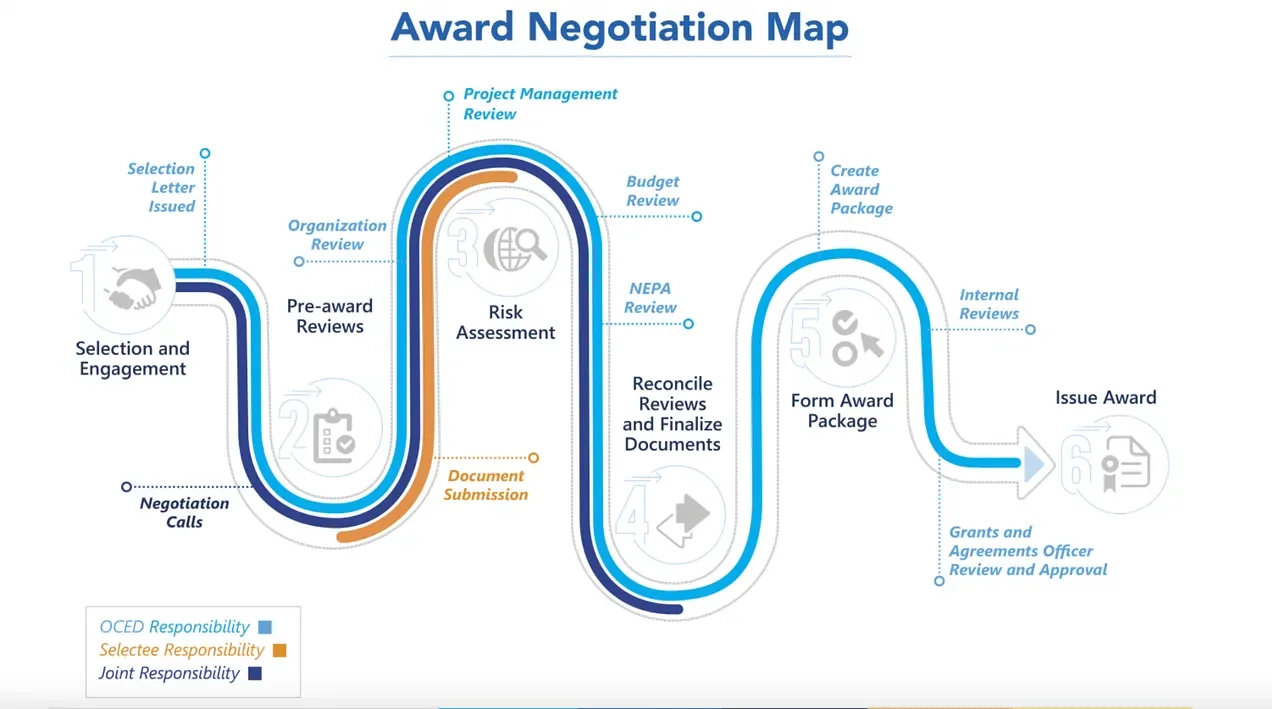
For the Hydrogen Hubs program, one of the largest project negotiations, this end-to-end negotiations spanned nine months for a phase one award.
Rigor and Due Diligence
The substantial upfront investment in due diligence, from merit review through project award, was designed with a single overarching goal: ensuring that IIJA and IRA projects had the highest possible probability of reaching successful operation. DOE understood that any significant work stoppage on these large-scale, capital-intensive projects could jeopardize their long-term viability and undermine the return on the public's investment.
Projects interrupted during active design or development phases face cascading impacts to schedule and budget that grow more costly the longer work is paused. Sustaining this effort through completion is not only a matter of program integrity, it is essential to delivering the return on taxpayer dollars that this major public investment was designed to achieve.
The rigor and approach, built on DOE’s long-standing review and negotiation processes, can be applied to future large scale demonstration and deployment project selections. This framework should also provide confidence that the right projects will be chosen, with clear mechanisms to exit if project viability changes.
While detailed information on IIJA and IRA project status during FY25 remains limited, reports indicate that the slowdown in funding has placed billions of dollars in active projects at risk. The trust built between DOE and project teams through years of rigorous due diligence and negotiation is itself an asset, one that is difficult to rebuild once damaged. Failing to honor commitments already made risks eroding that trust not only with current awardees, but with the broader industry partnerships DOE will need for future energy programs.
###
This piece was drafted by trusted and vetted alumni of the U.S. Department of Energy. Any views and opinions expressed are that of the author(s) and do not reflect those of the DOE Alumni Network.